
Beyond Key Length: Why Quantum-Ready Security Begins with Entropy
In cybersecurity, encryption is often regarded as the gold standard—the final word in data protection. It’s the digital equivalent of a vault: put your data inside, lock it with a key, and only those with the correct credentials can ever access it. This perception has shaped industry standards for decades, fueling a singular focus on key length as the primary measure of strength. From 128-bit AES to 256-bit upgrades, and now rumblings about future 512-bit implementations, the logic seems straightforward: the longer the key, the harder it is to crack.
But that logic, while intuitive, is incomplete—especially in the face of quantum computing. As adversaries gain access to quantum-capable resources, traditional assumptions about encryption strength begin to unravel. And at the heart of this shift is a deceptively simple, but profoundly important concept: entropy.
What Is Entropy, Really?
In cryptography, entropy refers to the unpredictability or randomness used to generate cryptographic keys. It’s not the key length that matters—it’s how many bits of that key are actually random and unknowable to an attacker. A 256-bit key generated with only 40 bits of entropy might appear secure on paper, but in practice, it’s as brittle as a combination lock with only a few usable digits.
Think of entropy as the raw material that makes a key strong. The more entropy, the more difficult it is for any attacker—quantum or classical—to predict or brute-force that key. Without sufficient entropy, encryption becomes a mere illusion of security, especially against adversaries equipped with advanced computational capabilities.

Figure 1: Various entropy measures used in cryptography. (Source: Source: ResearchGate – Entropy measures and related concepts used in cryptography
The Fallacy of “Bigger Is Better”
The cybersecurity industry has largely treated key length as a proxy for strength. And for good reason—in classical computing environments, longer keys have historically required exponentially more effort to break via brute-force attacks. But quantum computing changes the rules.
Using Grover’s algorithm, a quantum computer can reduce the effective security of symmetric encryption by a square root factor. That means a 256-bit key offers roughly the same effective security as a 128-bit key if the key is random. But—and this is the key point—if the entropy behind that 256-bit key is low, the quantum advantage becomes dramatically more potent.
A 256-bit key derived from a flawed or limited entropy source can be breached with far fewer operations than the math suggests. And unfortunately, that’s not a hypothetical scenario. As research increasingly shows, many real-world key generation routines—especially in embedded systems, virtualized environments, or poorly configured applications—rely on entropy sources that are limited, biased, or insufficiently vetted.

Figure 2: Circuit diagram illustrating Grover’s algorithm. (Source: ResearchGate – Circuit diagram for Grover’s algorithm.)
Why Entropy Now Sits at the Top of the Risk Stack
The cybersecurity industry has largely treated key length as a proxy for strength. And for good reason—in classical computing environments, longer keys have historically required exponentially more effort to break via brute-force attacks. But quantum computing changes the rules.
Using Grover’s algorithm, a quantum computer can reduce the effective security of symmetric encryption by a square root factor. That means a 256-bit key offers roughly the same effective security as a 128-bit key if the key is random. But—and this is the key point—if the entropy behind that 256-bit key is low, the quantum advantage becomes dramatically more potent.
A 256-bit key derived from a flawed or limited entropy source can be breached with far fewer operations than the math suggests. And unfortunately, that’s not a hypothetical scenario. As research increasingly shows, many real-world key generation routines—especially in embedded systems, virtualized environments, or poorly configured applications—rely on entropy sources that are limited, biased, or insufficiently vetted.
The Quantum Misconception: “Just Double the Key”
It’s tempting to assume that symmetric key cryptography is mostly safe from quantum threats. After all, asymmetric algorithms like RSA and ECC are directly vulnerable to Shor’s algorithm, while symmetric ciphers like AES “only” face a quadratic speedup via Grover’s algorithm. So the prevailing wisdom is simple: double your key size and move on.
But that wisdom rests on a dangerous assumption—that the key is truly random.
Quantum-resilient cryptography isn’t just about bit count. It’s about entropy density. A 256-bit AES key generated from only 32 bits of entropy is essentially a large padlocked door secured with a 3-digit combination. It looks secure from the outside, but a quantum attacker using Grover’s algorithm could break it orders of magnitude faster than the system designers assumed.
In recent technical and field discussions across defense, critical infrastructure, and SaaS security environments, this realization is now front and center. In one internal briefing, a cybersecurity architect noted that most deployed enterprise systems today are generating keys with entropy pools as low as 32 to 64 bits, despite specifying 256-bit AES keys. That’s not theoretical—it’s the default configuration in many legacy systems, IoT firmware stacks, and improperly implemented key generation APIs.
Understanding the Entropy Inflection Point
According to research from academic and industry cryptographers—including the detailed modeling found in the Quantum Entropy Report v6.1—there is an observable inflection point for entropy effectiveness at around 220 bits.
Below that threshold, Grover’s algorithm becomes practically viable within a timeframe measurable in months or years, not centuries. Above it, the computational workload scales dramatically, restoring the defensive advantage of symmetric encryption—at least for the foreseeable quantum horizon.
This research confirms what quantum hardware researchers are quietly warning: as gate fidelity improves and logical qubit error rates decrease, the real bottleneck to successful quantum attacks may shift from compute power to entropy quality. The “math” of encryption may remain strong—but only when the randomness is real.

Figure 3: The relationship between entropy levels and vulnerability to quantum attacks. (Source: Quantum Entropy Report v6.1 – Figure on AES key vulnerabilities via Grover’s Algorithm. )
NIST and CISA: The New Mandate for Secure Entropy
For years, cybersecurity standards bodies have issued quiet—but increasingly urgent—warnings about a foundational risk hiding beneath the surface of cryptographic systems: entropy.
This isn’t merely a technical concern reserved for cryptographers. It’s now recognized as a core security dependency—on par with patch management, identity access controls, and zero trust segmentation. At the forefront of this shift are agencies like the National Institute of Standards and Technology (NIST) and the Cybersecurity and Infrastructure Security Agency (CISA), which have both elevated entropy to a top-tier design concern in the post-quantum era.
NIST SP 800-90B: Entropy Is Not Optional
One of the most critical documents on this topic is NIST Special Publication 800-90B, titled Recommendation for the Entropy Sources Used for Random Bit Generation. In it, NIST lays out a clear and unequivocal stance: the unpredictability of a cryptographic key is more important than its length. If the source of entropy used during key generation is biased, predictable, or tampered with, the resulting key—even if 256 bits long—is inherently insecure.
“Entropy is the root of security. The number of bits in a key is irrelevant if they are predictable or influenced.”
— NIST SP 800-90B
This document formalizes rigorous guidelines for evaluating, testing, and certifying entropy sources. It introduces metrics like min-entropy (the worst-case unpredictability) and defines frameworks for entropy health testing, noise source validation, and conditioning functions. For any organization generating keys—whether in software libraries, hardware modules, or embedded devices—SP 800-90B effectively serves as the blueprint for cryptographic trustworthiness.
Yet despite its clarity, SP 800-90B is still often misunderstood or ignored in mainstream development practices. That gap has serious consequences—particularly as quantum computing becomes operationally relevant.
Entropy-as-a-Service (EaaS): Fixing the Infrastructure Gap
Recognizing that many modern devices—especially IoT nodes, VMs, and edge appliances—lack strong hardware entropy sources, NIST also introduced a conceptual solution: Entropy-as-a-Service (EaaS).
EaaS enables constrained environments to request high-quality entropy over secure channels, drawing from externally managed entropy pools that are validated and replenished through cryptographically secure, physically random, or even quantum-measured inputs.
This is particularly useful for:
- Virtualized environments, where software-based randomness can be deterministic.
- Air-gapped or offline systems, which may need pre-buffered entropy vaults.
- Fast-scaling infrastructure, where devices are spun up faster than they can securely gather entropy locally.
EaaS doesn’t eliminate the need for entropy audits—it raises the bar, making it possible to treat entropy as a shared resource, much like cloud compute or DNS. It represents a shift in mindset: entropy isn’t just generated—it’s provisioned, monitored, and verified.
NCCoE’s PQC Migration Guide: The Entropy Dependency in Quantum-Readiness
In its Post-Quantum Cryptography (PQC) Migration Project, NIST’s National Cybersecurity Center of Excellence (NCCoE) echoes this emphasis. The guide (SP 1800-38C) acknowledges that migrating to quantum-resistant algorithms is meaningless if the entropy used to generate keys, seeds, and signatures remains flawed.
Too often, organizations believe that switching to a post-quantum algorithm (e.g., CRYSTALS-Kyber or SPHINCS+) makes them “quantum safe.” But these algorithms, like their classical predecessors, are only as secure as the randomness underpinning them. If the entropy is insufficient or compromised, even post-quantum primitives can be trivially undermined.
The NCCoE guide recommends:
- Evaluating the entropy sources in certificate authorities, key provisioning systems, and device enrollment flows.
- Tracking entropy throughout the cryptographic lifecycle, not just at the point of key generation.
- Considering entropy validation as a compliance checkpoint in post-quantum transition plans.
- The implicit message is clear: a quantum-resistant algorithm without quantum-resilient entropy is a house built on sand.
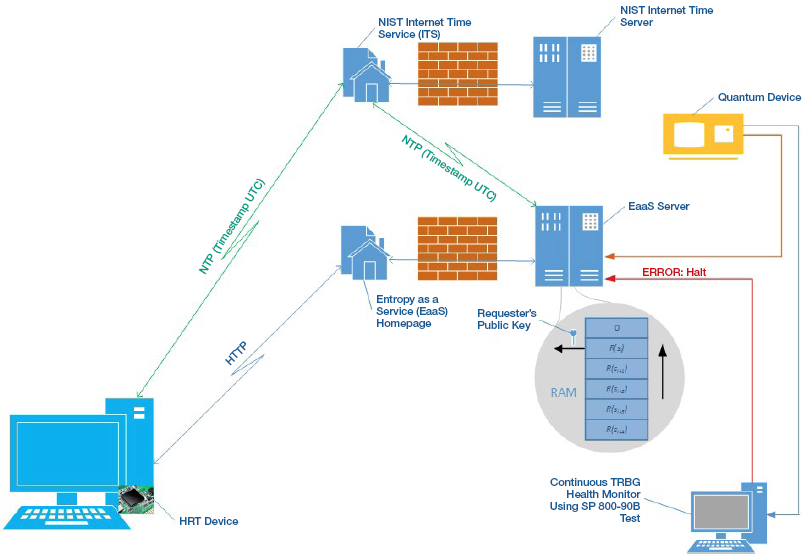
Figure 4: Diagram of NIST’s Entropy as a Service (EaaS) architecture. (Source: NIST – Entropy as a Service Architectures. )
CISA and Zero Trust: Entropyasa Hygiene Metric
CISA, the lead cybersecurity agency under the U.S. Department of Homeland Security, has also brought entropy into the strategic conversation—particularly through its Zero Trust Maturity Model. While Zero Trust is often associated with identity, segmentation, and network controls, CISA’s expanded guidance highlights the importance of cryptographic hygiene and key lifecycle integrity.
Within that, entropy monitoring and secure key generation are now considered essential to achieving cryptographic maturity. Specifically, CISA recommends:
- Ensuring entropy sources are trustworthy and tested as part of the development pipeline.
- Treating key generation as a logged and auditable event, not a silent black-box operation.
- Validating that both cloud-based and on-prem systems meet entropy compliance standards.
This positions entropy not just as a background function—but as a governance issue, tied to regulatory frameworks, operational risk, and incident response preparedness.
A Turning Point for Cybersecurity Architecture
Together, NIST and CISA are doing more than issuing recommendations. They are shifting the security conversation—from what algorithms we use to how we generate and maintain trust in our cryptographic systems. And entropy is the linchpin.
- Entropy is no longer a backend concern—it is now a front-line issue.
- Entropy health should be monitored as proactively as endpoint telemetry or MFA posture.
- Entropy generation and sourcing should be a tracked event in CI/CD pipelines.
- Auditable entropy validation should be part of cloud and edge compliance checklists.
As organizations plan their post-quantum migrations, it’s tempting to focus on the exciting parts—faster algorithms, advanced certificates, novel cryptographic primitives. But none of that will matter if the building blocks remain predictable.
In that sense, the call from standards bodies is not just technical—it’s philosophical: we must stop thinking of entropy as a system resource and start treating it as a security asset.
Why Most Organizations Aren’t Ready
Despite the clarity of the threat, the entropy problem remains largely unaddressed at scale. Why?
False Confidence in Key Length
Developers and IT teams are trained to pick strong-sounding algorithms—AES-256, for instance—but often rely on defaults or flawed pseudo-random number generators (PRNGs) when generating keys.
Legacy Infrastructure
Many legacy systems simply weren’t designed with entropy constraints in mind. Entropy starvation is common in embedded devices, firmware, and virtualized environments.
Lack of Visibility
Organizations rarely audit entropy health. Most security teams monitor traffic, endpoints, or encryption use—not the quality of the cryptographic foundation itself.
Incompatibility with Air-Gapped and Offline Systems
Air-gapped environments, especially in defense or SCADA systems, often lack secure ways to update entropy pools or fetch real-time randomness. This makes them particularly vulnerable to entropy degradation over time—a problem some groups are now solving with high-volume entropy caching and secure offline transport (e.g., using pre-validated SSDs or QRNG-based entropy vaults).

Figure 5: Flowchart illustrating the entropy estimation process as per NIST SP 800-90B. (Source: ResearchGate – Entropy estimators of NIST SP 800-90B. )
Strategic Implications: Entropy as an Operational Vector
In practical terms, entropy will become an operational planning factor in enterprise and government security architectures.
This includes:
- Entropy-aware encryption policies: Defining minimum entropy thresholds per application or user type.
- Quantum entropy pools: Pre-generating large, verified entropy blocks for deployment in secure environments.
- Dynamic entropy metering: Monitoring entropy usage across systems and flagging depletion or risk thresholds.
- Hybrid entropy generation: Combining classical and quantum sources to balance availability with unpredictability.
- In the same way we’ve adapted to container security, cloud segmentation, and endpoint zero trust—entropy hygiene will emerge as a measurable compliance target.
The cost of failing to do so? Retroactive re-encryption of years’ worth of data. If quantum attack capability becomes available before this problem is solved, organizations may be forced into massive operational lifts—re-opening and re-encrypting every archived file, every stored credential, every certificate. The burden isn’t theoretical. It’s just deferred.

Figure 6: Integration of entropy sources within a secure system architecture. (Source: ResearchGate – High-level Block Diagram of the Entropy Source.)
What the Future Looks Like: Designing with Entropy First
If we want cryptographic systems that survive the quantum decade, we must change the way we think about randomness.
Not as a hidden detail.
Not as a systems engineering edge case.
But as a primary design input.
That means securing entropy at the hardware level, verifying it during key provisioning, and continuously monitoring its health at runtime. It means rejecting “safe defaults” and embracing entropy transparency. And it means investing in standards-driven, scalable ways to deliver quantum-safe randomness wherever it’s needed—whether in cloud VMs, air-gapped defense networks, or zero-trust edge deployments.
Because in a world where quantum adversaries don’t need to break your math—they just need to guess your secrets—entropy is the first line of defense.

Figure 7: Current trends in the application of entropy in cryptography. (Source: MDPI – The Odyssey of Entropy: Cryptography.)
References
NIST SP 800-90B
https://csrc.nist.gov/publications/detail/sp/800-90b/final
NIST SP 800-90C
https://csrc.nist.gov/publications/detail/sp/800-90c/final
Quantum-Entropy Report v6.1
https://atis.org/wp-content/uploads/2023/02/Quantum-Entropy-Report-v6-1.pdf
National Academies Report
https://nap.nationalacademies.org/catalog/25196/quantum-computing-progress-and-prospects
MDPI Journal
https://www.mdpi.com/1099-4300/27/3/221
ResearchGate – Quantum Entropy Encryption in Military Systems
https://www.researchgate.net/publication/387808908
NIST NCCoE PQC Migration Guidelines
https://www.nccoe.nist.gov/sites/default/files/2023-12/pqc-migration-nist-sp-1800-38c-preliminary-draft.pdf
Researchgate – Entropy Measures And Related Concepts Used In Cryptography
https://www.researchgate.net/publication/358565921_The_Odyssey_of_Entropy_Cryptography?_tp=eyJjb250ZXh0Ijp7ImZpcnN0UGFnZSI6Il9kaXJlY3QiLCJwYWdlIjoiX2RpcmVjdCJ9fQ
Researchgate – Circuit Diagram For Grover’s Algorithm
https://www.researchgate.net/publication/339798681_Quantum_attacks_on_some_feistel_block_ciphers?_tp=eyJjb250ZXh0Ijp7ImZpcnN0UGFnZSI6Il9kaXJlY3QiLCJwYWdlIjoiX2RpcmVjdCJ9fQ
NIST – Entropy as a Service Architectures
https://csrc.nist.gov/projects/entropy-as-a-service/architectures
ResearchGate – Entropy Estimators of NIST SP 800-90B
https://www.researchgate.net/publication/388526151_Observations_on_NIST_SP_800-90B_entropy_estimators?_tp=eyJjb250ZXh0Ijp7ImZpcnN0UGFnZSI6Il9kaXJlY3QiLCJwYWdlIjoiX2RpcmVjdCJ9fQ
ResearchGate – High-Level Block Diagram of the Entropy Source
https://www.researchgate.net/publication/360278747_Intensify_Assured_PHR_Sharing_in_Cloud_Using_Entropy_Based_Signature_Cryptosystem?_tp=eyJjb250ZXh0Ijp7ImZpcnN0UGFnZSI6Il9kaXJlY3QiLCJwYWdlIjoiX2RpcmVjdCJ9fQ
MDPI – The Odyssey of Entropy: Cryptography
https://www.mdpi.com/1099-4300/24/2/266

View PDF
Talk To A Specialist
Our expert team at EntropiQ is here to guide you through the complexities of post-quantum entropy. Simply click the button to the right and fill out the form to get in touch with us.